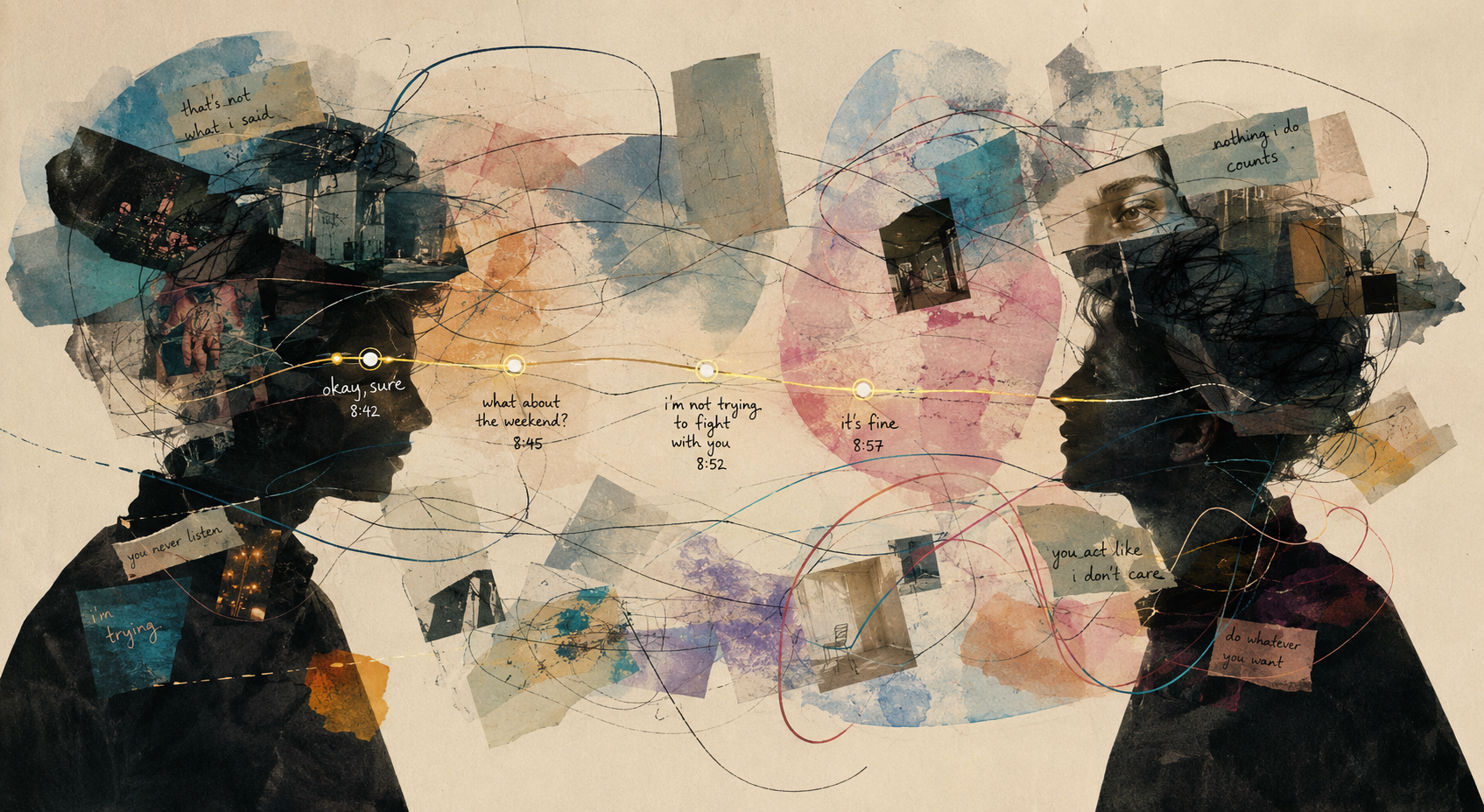
What AI hears in your arguments that you miss
Neither of you remembers the fight accurately. Here is what a neutral read-back of an argument actually catches, and how to use it without weaponizing it.
August 13, 2026
·
4
min to read

September 7, 2026
You can usually feel it before you can name it. You finish an ordinary evening together and you are wrung out, foggy, a little smaller than you were that morning, and you cannot point to a single thing that went wrong. So you ask yourself the quiet question: is this relationship wearing down my mental health, or am I just bringing my own stuff into it? Wanting to protect your own wellbeing here is not selfish, and it does not mean you love the person less. It usually means some part of you has been keeping score for a while.
Here is a pattern we see constantly in Maia conversations. Someone describes how much energy now goes into managing the relationship, smoothing things over, reading the room, bracing for the next hard night, and they realize there is almost nothing left over for themselves. They are not in crisis. They have just slowly stopped tending to their own mind, one small concession at a time, and they did not notice the cost until it had already added up.
That is the thing about this kind of drain. It rarely announces itself. It shows up as signs, and the signs are easy to explain away one by one. Here are the ones worth taking seriously.
None of these means your relationship is doomed. Each one is information, a small flag that the way you are doing this is costing you more than it should.
One or two of these on a rough week is just being human. Several of them, as the baseline, most weeks, is your mind telling you something it has known for a while.
This is the part the guilt gets wrong. Taking care of your own mental health is not you giving up on your partner, and it is not a verdict that they are bad. You can love someone and still find that the way the two of you operate is draining you. You can also be carrying your own anxiety or low mood that predates them and colors everything, so that even a steady partner feels heavy. It is almost never cleanly one or the other.
A rough read on which it is helps you aim. If the heaviness lifts when you have space, eases around other people, and clusters right after certain interactions, the dynamic is doing a lot of the work. If it follows you everywhere, into time alone and time with friends, and was there before this person, more of it is yours to tend directly. Usually it is some of both, which means two tracks at once: get your own struggle its own care, and address the dynamic honestly. Either way, the conclusion is the same. Your wellbeing is allowed to matter while you are still in the relationship, not only after it is perfect.
Not a grand exit. Mostly small, unglamorous, repeatable things that give you back some ground.
Notice the line here. Real self-care gives you more capacity to show up, not a way to quietly disappear from the relationship. If "protecting yourself" has become a slow exit you are not naming, that is worth being honest with yourself about too.
Say you do all of it. You put your own life back, you get your anxiety or low mood into care, you name the dynamic clearly and kindly. And you still feel diminished every single time you turn back toward the relationship. At some point the question stops being about your technique and becomes about whether the dynamic is willing to change.
Watch how your partner receives "I need to take care of myself." Can they hear it as a normal, reasonable thing? Or does your self-care reliably get met with guilt, sulking, or punishment? A partner who treats your wellbeing as a threat, who seems to need you depleted to feel secure, or who controls your time, your friendships, or your space, is not a problem you can self-care your way out of.
If you are sitting with the harder version of this, trying to sort out what is yours to carry, what is the relationship's to change, and how much you have already given, it can help to talk it through with something that asks the right questions and reflects your own situation back to you instead of handing you a generic answer. That is what Maia is for: a calm, private place to figure out how to protect your own mind without giving up on the person you love, and to see clearly when protecting yourself has to come first.


Like It? Share this article:
Our Mission & Editorial Standards
At Maia, we're passionate about helping couples thrive. That's why we prioritize providing you with accurate, actionable, and science-backed content.
Our blog posts are grounded in the latest research on relationships, communication, and psychology. We work closely with a team of relationship experts to ensure our content reflects the most up-to-date knowledge in the field.
Our goal is to empower you with the knowledge and skills you need to create a fulfilling and lasting relationship.
Stay tuned for insightful articles, expert advice, and practical tips – all designed to help your love story flourish.